
What should my active calorie burn target be/How much physical activity is optimal for fat loss?
Lots of people have been led to believe that 80% of your effort at achieving your ideal body composition is spending multiple hours a day at the gym doing structured exercise.
While structured exercise has tons of benefits, which are specific to the program methods that govern your exercises, getting the optimal 5-8 hours of moderate intensity physical activity per week delivers many body composition, metabolic health, concentration, productivity, flexibility, posture, cardiovascular, and longevity benefits.
A recent study, published in 2023 with 350 overweight/normal weight adults (40-65 years old), showed that subjects who did:
300-500 minutes per week of moderate physical activity (i.e leisure walking, cleaning, yard work, biking, kayaking, rollerblading, skateboarding) upgraded the quantities and diversity of their gut microbiome
Those who thought more is better, and did 750-1200 minutes per week, resulted in a significant decrease in the quantity and diversity of their gut microbiome
Moderate physical activity doing whatever you enjoy without eating/drinking any calories 2-3 hours prior gives you the following benefits:
Directly burns body fat
Upgrades your gut microbiome (heavily influences your weight, hormones, blood markers, cardiovascular health, stress levels, and longevity)
Increases short chain fatty acid production from the good gut bacteria and starves the bad gut bacteria
The power of walking for better blood sugar control
One thing that you can do to help you drive down your blood sugar levels to help you lose weight and reclaim your health is after every meal, go on a 20 minute walk. Taking a 20 min walk after a meal will decrease your 2 hour blood sugar increase by 50%. That isn’t an excuse to eat a bunch of high sugar crap, because you now know a neat loophole that helps keep blood sugar levels low. Doing this can easily get you back into a fat burning state 1 hour quicker after every meal.
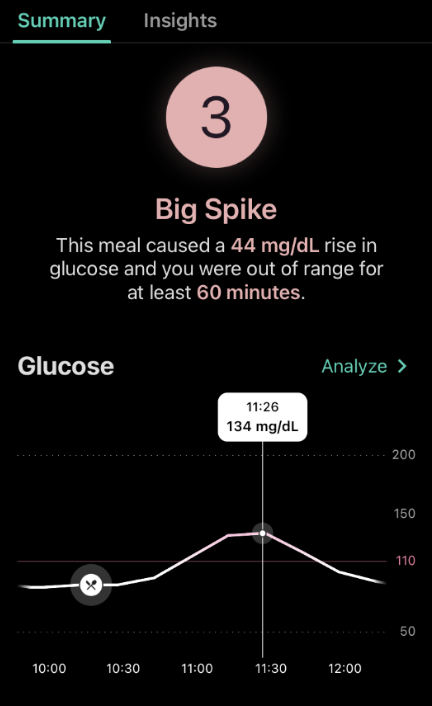
If you look at the image on the left, I intentionally ate a meal that is terrible for my genetics, gut bacteria composition, and metabolic health. I ate 1 seasoned chicken thigh, brown rice, and steamed carrots resulting in a blood sugar spike of 44mg/dL.
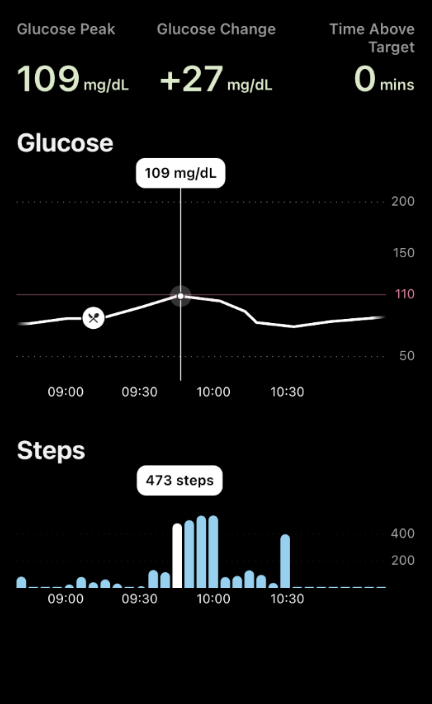
If you look at the image on the right, the next day I ate the same meal and immediately went for a 20 minute walk resulting in a blood sugar spike of only 27mg/dL.
Just by adding a moderate pace walk for 20 minutes I kept my blood sugar 40% lower and I returned to a fat burning state in 1 hour vs 2 hours.
Getting up every 20 minutes from sitting while working and doing a 2 minute minimum light walk lowers your blood sugar by 9% and insulin levels by 21%
Walking increases blood flow to the brain to boost concentration and productivity
It does this by stimulating the release of Brain Derived Neurotrophic Factor (BDNF)
BDNF causes your brain to make new neural connections and keep growing just like it did when our brains were developing as kids. This is important as we get older for maintaining our ease of mental clarity, memory recall, being able to continuously learn new skills/information, and avoid alzheimers/dementia.
How much walking do I need to do?
If you have an iPhone or an android phone, they both come with a health app that is always tracking how many steps you take in a day. Open the health app on your phone, go to the activity section, poke your steps category, and then you can look at what your average number of steps has been for the last day, week, month, and year. If you’re averaging less than 5000 steps, then I challenge you to increase the amount of walking and other movement activities in your daily life until you achieve 5000 steps. This is the bare minimum I'd recommend you aim for to tap into the brain boosting benefits of walking. If you’re already averaging 5000 steps, increase it to 7,500 or even 10,000 steps. It isn’t about how many steps you take in 1 day but what is your consistent daily, weekly, monthly, and yearly average that will give you the most benefit.
Walking reverses the muscle imbalance effects of sitting
For people that sit for prolonged periods of time at home, in an office building, or commuting, there are a number of muscular changes that the body starts making to become more efficient at sitting.
The hamstrings and butt get put in a lengthened and tight condition, the quads (top of your legs) and hip flexors (front of your hips) get put in a contracted condition. This results in tight and overactive quads/hip flexors that need less tension, and tight/weak hamstrings and butt muscles that need strengthening.
If this goes unchecked then that results in a significant tight and weak low back, slouching, tight and weak muscles around your shoulder blades, tight and overactive chest and shoulder muscles, and then a tight and weak neck. These problems take months to correct, so don’t go down this path.
How much walking do I need to do?
For every hour that you sit during the day, you need to walk for 10 minutes. If you need to sit for 8 hours for your job, it only takes you 80 minutes to help fix the damage that caused you.
This amount of walking can be spread out however you want. You could build in a 5-10 min of walk every hour, walk 40 min before lunch, then eat for 20 min., walk 40 min before dinner, and then eat dinner.
Walking will lower your resting heart rate
Like with any muscle in your body if you use it, then it will adapt accordingly so that next time your body experiences that same stressor it gets easier each time. The heart will respond to the low intensity walking and make more oxygen carrying capillaries so that it can receive a larger oxygen supply at every contraction beat making it easier to keep up with the pace you were walking or how long you were walking. Less contraction beats per minute to handle your pace of walking = less contraction beats per minute to handle anything you do that is an easier task than you're walking effort. Having a lower resting heart in a resting state is associated with living a longer life. An excellent resting heart is 40-55 beats per minute.
Walking can specifically target the chamber of your heart where your blood goes after it has been replenished with oxygen resulting in a lower diastolic blood pressure (the bottom number)
Walking doesn't require doing something with moderate or heavy weights or demanding the body to increase its blood pressure to get blood to your working muscles to accomplish the task of walking. This gives the chamber of your heart more time to fill itself up with oxygen filled blood before it gets pumped out to your working muscles to keep up a moderate pace of walking. Your heart chamber walls are elastic like a rubber balloon. It can either become stiffer, like if you throw a balloon in the freezer, or it can become more stretchy, like if you keep a balloon in a tropical climate. The more stretchy it is, the more blood it can hold in there at a time, and the lower your diastolic blood pressure (the bottom number of 120/80) will be.
Your body can only burn a certain number of calories per day
This is a fail safe mechanism so that you can't exercise yourself to continuous weight loss and die. The more stress you have to deal with on a given day and how poor your sleep quality was last night will significantly reduce that energy expenditure number that you can burn.
If you exceed your calorie limits then you'll enter what is called recovery debt. Recovery debt is like a bank loan, but it needs to get paid back before you can get your body back to a point where it can actually expend energy that will lead to fat loss again. You want to stay as far away from recovery debt as possible, unless you'd like to halt your fat loss capability, no matter what you do.
How many calories can my body burn per day in the perfect world?
If you take your resting metabolic rate (calculated here) x 2.5 this will show you your max calorie expenditure.
To calculate your max active burnable calories (between movement and exercise) take your max calorie expenditure - resting metabolic rate
Want a comfort cushion active calorie burn target?
Take your (resting metabolic rate x 1.8) - resting metabolic rate would be an effective amount yet avoid recovery debt and plateauing your ability to burn any more body fat.
What about if you have a poor night sleep OR lots of stress that day?
Take your active burn target and multiply it by 70%
What about if you have a poor night sleep AND lots of stress that day?
Take your active burn target and multiply it by 40%
References
Loretta DiPietro, Andrei Gribok, Michelle S. Stevens, Larry F. Hamm, William Rumpler; Three 15-min Bouts of Moderate Postmeal Walking Significantly Improves 24-h Glycemic Control in Older People at Risk for Impaired Glucose Tolerance. Diabetes Care 1 October 2013; 36 (10): 3262–3268
O'MARA, S. (2019). IN PRAISE OF WALKING. London: The Bodley Head.
Pulsford, R. M., Blackwell, J., Hillsdon, M., & Kos, K. (2017). Intermittent walking, but not standing, improves postprandial insulin and glucose relative to sustained sitting: A randomised cross-over study in inactive middle-aged men. Journal of science and medicine in sport, 20(3), 278–283.
Recover to Win Online Course by Joel Jamieson
Shah, S. et al. (2023) ‘Physical activity‐induced alterations of the gut microbiota are bmi dependent’, The FASEB Journal, 37(4). doi:10.1096/fj.202201571r.
Next Steps
Click Here to Schedule your next Lifestyle Coaching Session
When you get near the end of scheduling this click “redeem coupon, package, or gift certificate” button (located above pay now)
Type in your package code and click apply
Then click the reserve button